
Low disk space is a common issue in Windows Server 2016, especially on the system partition (the C drive). To resolve this problem, you have two options. The traditional method is to back up everything, recreate partitions, and restore data, which takes a significant amount of time. A much better alternative is to extend the partition by moving free space from another volume. To extend a partition in Windows Server 2016, two types of utilities are available: the built-in Disk Management tool and third-party disk partitioning software. Due to numerous restrictions, Disk Management is often not the ideal choice. This article explains how to extend a volume in Windows Server 2016 using both options.
About Windows Server 2016 Extend Volume Function
Disk partitions are originally allocated during the installation of the operating system or assigned by server OEMs. After running the server for a period of time, the system C drive may get full. Traditionally, you would need to perform backups, recreate partitions, and restore everything, a process that could easily consume an entire day.
Starting with Windows Server 2008, Microsoft integrated a new "Extend Volume" function into its native Disk Management tool. This feature allows administrators to increase partition size without data loss in most circumstances.
However, only a limited number of partitions can be extended by this native tool due to structural restrictions. The Windows Server 2016 "Extend Volume" function was inherited directly from the older Server 2008 codebase without any major improvements. Many server administrators report that they cannot extend partitions with this utility, meaning you will still require third-party software to extend a Server 2016 volume in most scenarios.
How to Extend Volume in Windows Server 2016 Without Software
- Press Windows + X simultaneously on your keyboard and then click Disk Management from the menu list.
- Right-click the adjacent partition on the right side (such as the D drive) and select "Delete Volume".
- Right-click the adjacent partition on the left side (such as the C drive) and select "Extend Volume".
![Extend Volume]()
- The "Extend Volume Wizard" will launch; simply click Next to proceed.
- The available disk and maximum space are selected by default; click Next to continue.
- Click Finish to confirm the settings and begin the extension process.
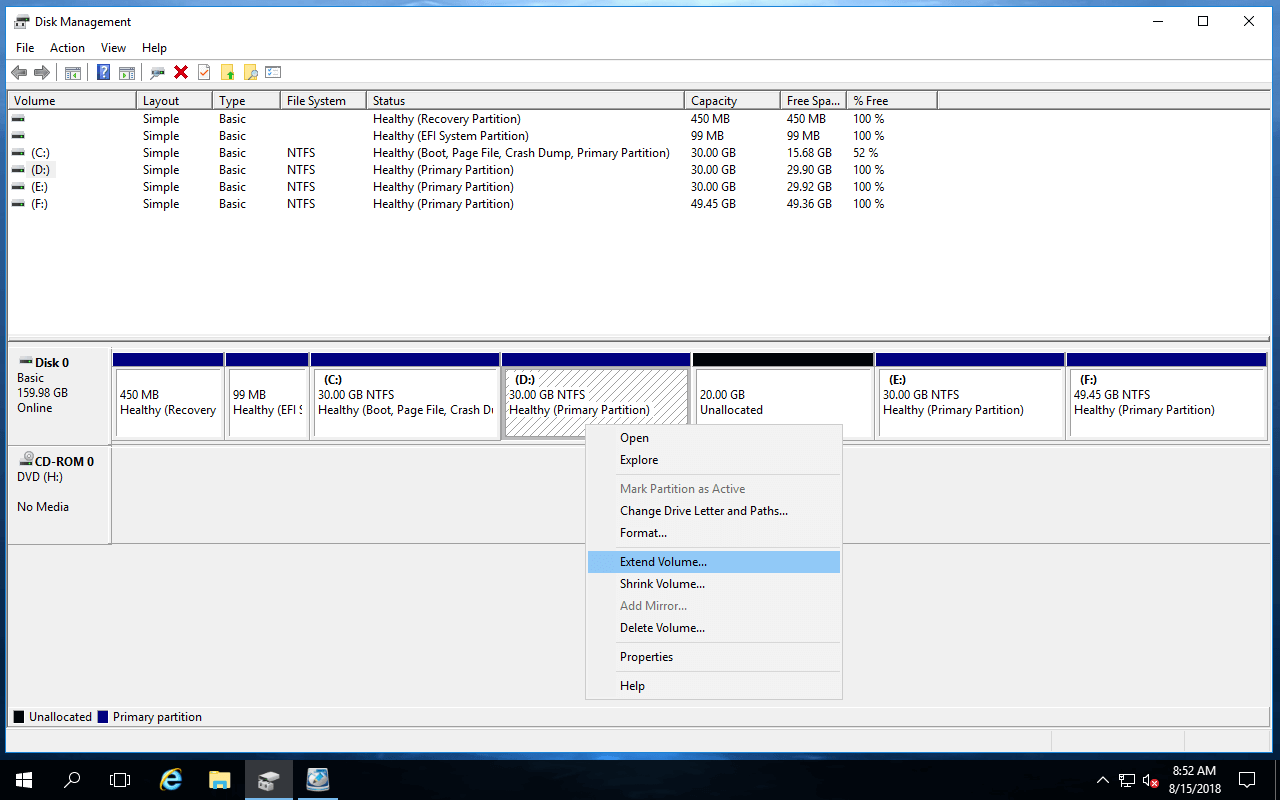
In most applicable scenarios, the left partition can be extended within a few moments.
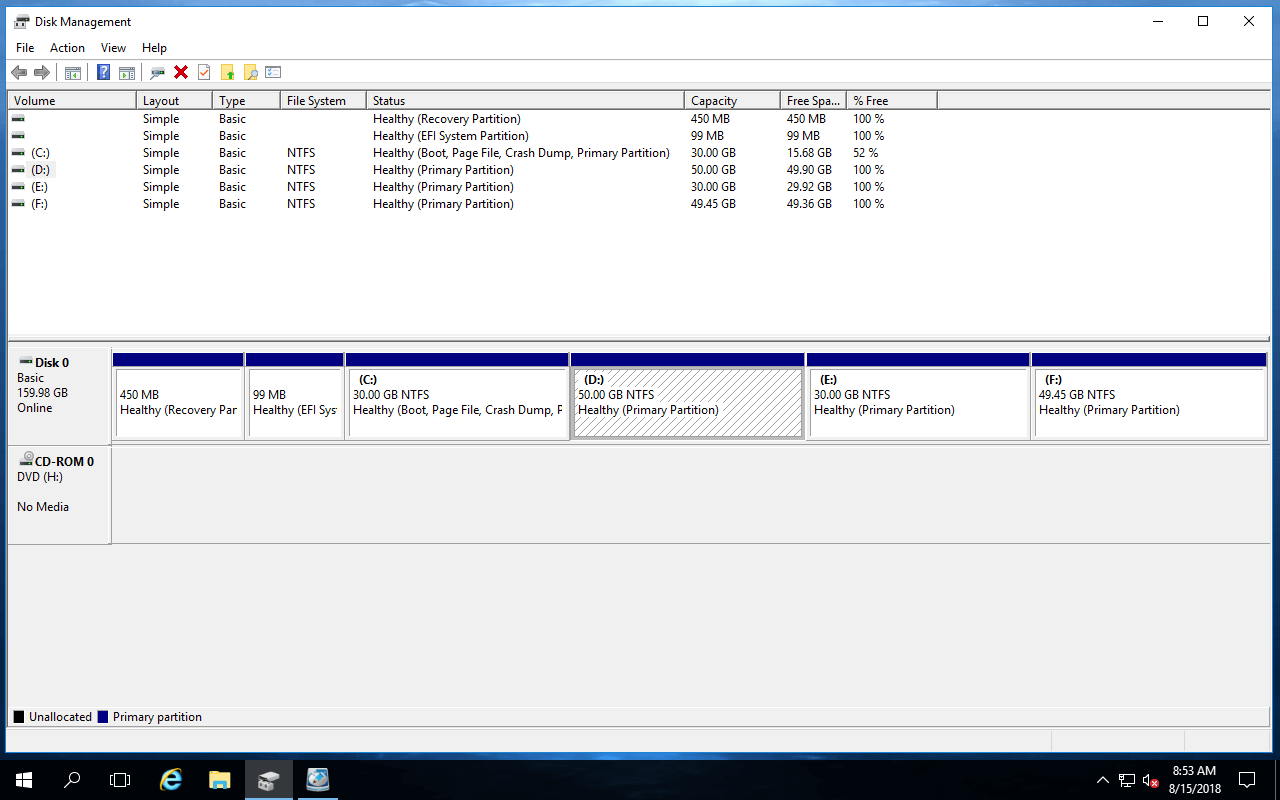
It is simple to extend a partition in Server 2016 via Disk Management when contiguous unallocated space exists on its immediate right side. However, you cannot obtain this required space simply by shrinking another partition using the native tool.
Limitations of Extending Server 2016 Partition via Disk Management
GPT and MBR are the most common partition styles for hard drives in Windows systems. If your disk is configured as GPT, there are two primary restrictions encountered when extending partitions via Disk Management in Server 2016. If your disk is MBR, you will face two additional structural limitations.
① Cannot Extend a Partition by Shrinking Another One
There is a companion "Shrink Volume" function in Disk Management. Many administrators attempt to shrink the D drive to generate unallocated space, only to find that it is impossible to add that unallocated space into the C drive. This represents the most widespread complaint encountered when trying to extend a volume via Disk Management in Windows Server 2016.
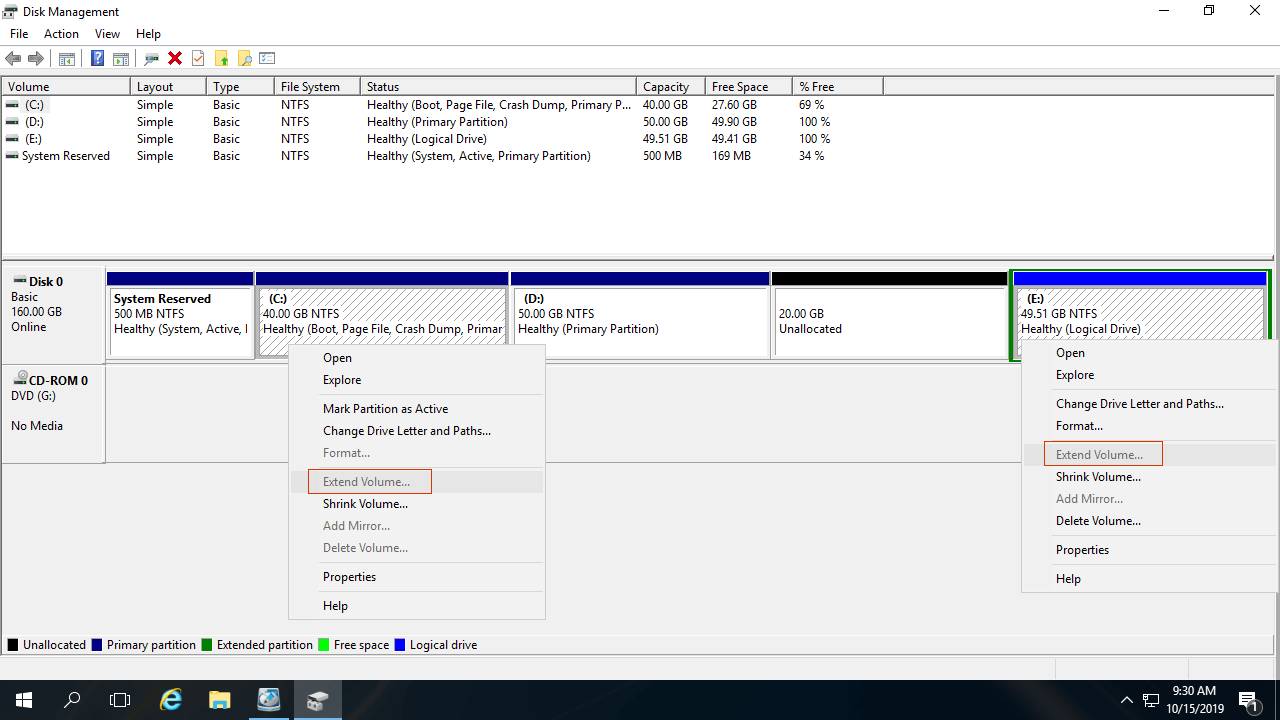
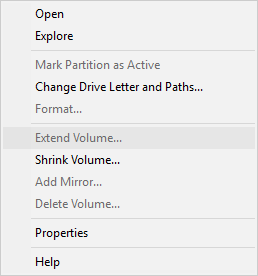
As illustrated in the screenshot, the Extend Volume option is greyed out for both the C and E drives after shrinking the D drive.
This occurs because "Extend Volume" strictly requires adjacent unallocated space on the right side of the target partition. Unfortunately, the "Shrink Volume" function cannot position the resulting space on the left of the shrunk partition.
In this scenario, the 20GB of unallocated space created from shrinking the D drive is non-adjacent to the C drive and sits on the left side of the E drive, which causes the Extend Volume function to be disabled.
② Cannot Resize FAT32 Partitions
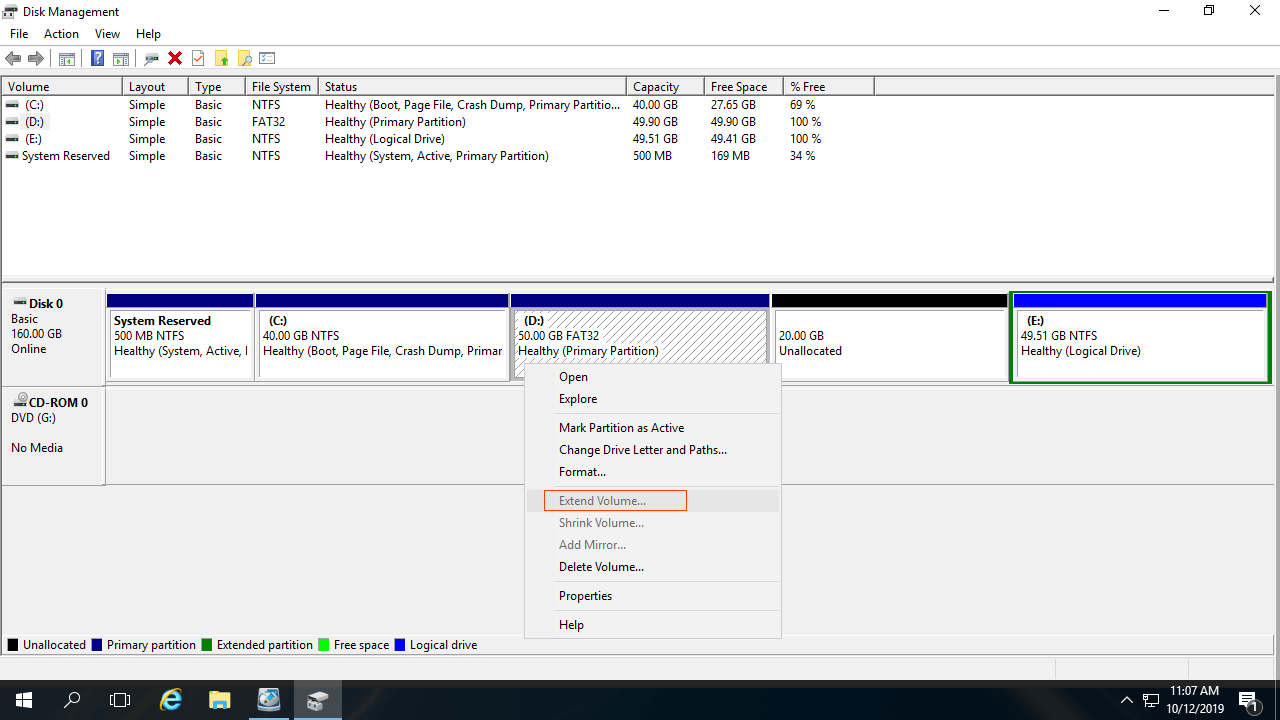
NTFS and FAT32 are the most prevalent file systems on Windows servers, but Disk Management cannot resize FAT32 partitions.
This means that if the partition you want to expand is formatted with the FAT32 file system, Disk Management cannot extend this partition even if there is contiguous unallocated space available on its right side.
③ Partitions for Deletion and Extension Must Be of the Same Type
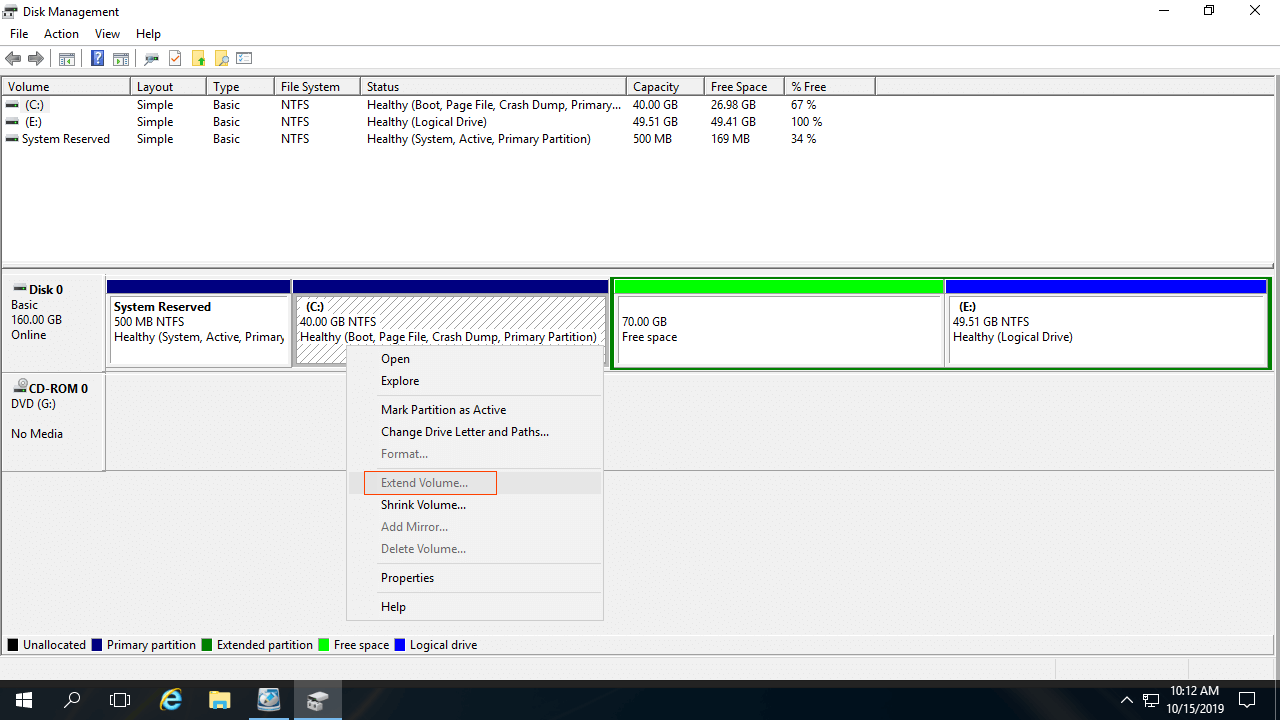
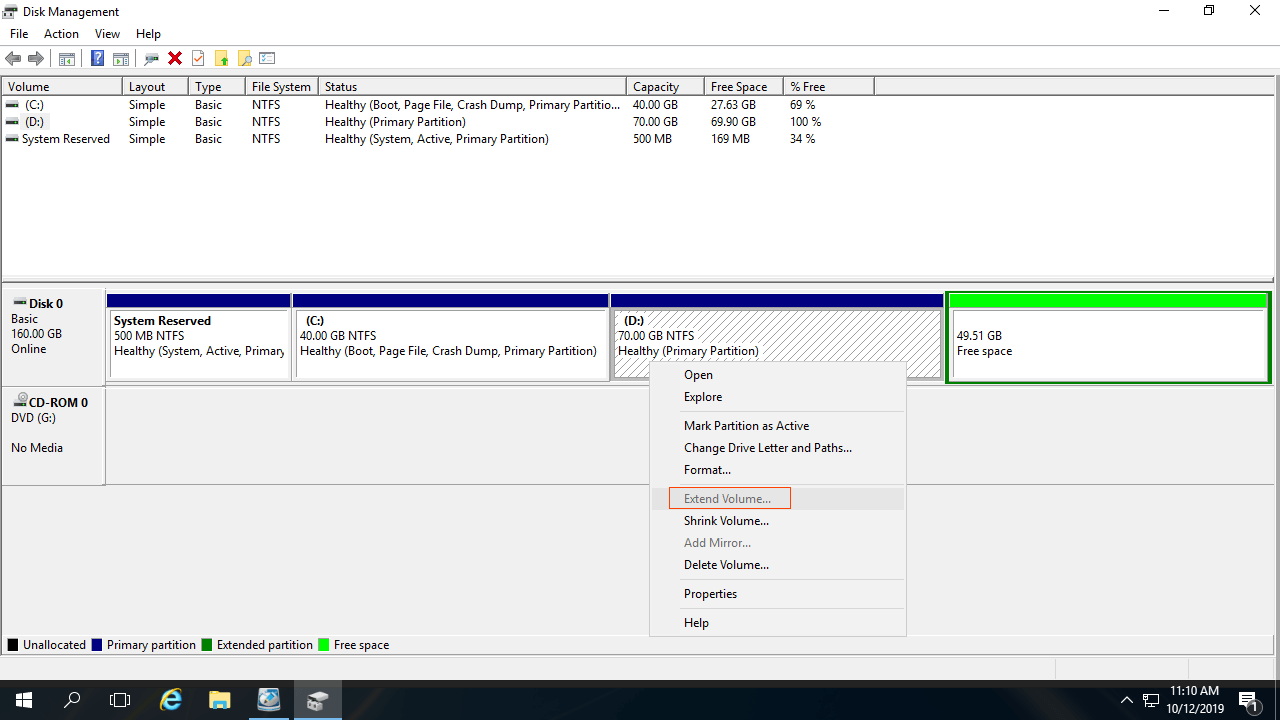
This structural restriction applies exclusively to MBR-style disks. The partition you want to extend and the contiguous volume you intend to delete on the right must both share the exact same partition type—either both Primary or both Logical. Otherwise, you will remain unable to extend the partition even after deleting the adjacent volume.
④ Cannot Extend Server 2016 Partition Past 2 TB
On MBR disks, there is another major downside: you can only utilize up to 2TB of disk space, even if your underlying physical disk or RAID array is 4TB or larger. The space beyond 2TB will be displayed as unallocated in Disk Management, and right-clicking it reveals no available options. If you need to extend a partition beyond the 2TB barrier, you must first convert the MBR disk to GPT style.
Better Way to Extend Partition in Windows Server 2016
With NIUBI Partition Editor Server, all these structural limitations are eliminated. Compared to native Windows Disk Management, it delivers several key advantages:
- It can effortlessly shrink and extend both NTFS and FAT32 partitions.
- It can generate unallocated space on either the left or right side while shrinking existing volumes.
- It can merge unallocated space into an adjacent partition in a single step, regardless of whether it is NTFS, FAT32, Primary, or Logical.
- It can move and combine unallocated space into any non-adjacent partition located on the exact same disk.
- It provides a much simpler user experience—you simply click, drag, and drop directly on the visual disk layout map.
- It features advanced capabilities such as merging, cloning, converting, defragmenting, wiping, hiding partitions, and scanning for bad sectors.
While multiple applications can assist you in extending partitions within Windows Server 2016, very few provide adequate system safety, including native Disk Management. Standing out from other solutions, NIUBI Partition Editor incorporates innovative safeguards to protect your server environment and data:
- Virtual Mode - All configurations are initially staged as pending operations for preview; the real disk layout remains unchanged until you explicitly click "Apply" to confirm.
- Cancel-at-will - If you realize you applied an incorrect operation, you can safely abort the ongoing tasks midway without causing partition corruption.
- 1-Second Rollback - If any unexpected software or hardware error occurs during modification, the tool automatically reverts the server to its original state in an instant.
- Hot-Clone - Clone disk partitions without system interruption. You can clone your entire system drive prior to optimization and instantly boot from the backup drive if the source hardware malfunctions.
To extend a partition in Windows Server 2016 without data loss:
- Download NIUBI Partition Editor, right-click the D drive, select "Resize/Move Volume", and drag its left border toward the right in the pop-up panel.
- Right-click the C drive, choose "Resize/Move Volume" once more, and drag its right border toward the right side to merge the newly created unallocated space.
- Click Apply on the top-left toolbar to execute. Remember, any configurations made prior to this final confirmation step only run in Virtual Mode.
If you intend to expand a hardware RAID partition in Windows Server 2016 or enlarge a virtual disk inside VMware/Hyper-V, simply follow these exact same steps; there is no operational difference.
Watch the full steps to extend Server 2016 partition:
If there is no free space remaining on the current drive, no utility can extend a volume by drawing space from a separate, disconnected physical disk. In that scenario, you must follow the procedures to extend your partition by copying the volume onto a larger hard disk.
In Summary
The Windows Server 2016 "Extend Volume" function is structurally constrained to extending NTFS partitions by deleting the adjacent volume on their immediate right. Due to these limitations, native Disk Management remains ineffective in most real-world scenarios. To extend partitions in Windows Server 2016 and all other modern versions, NIUBI Partition Editor stands out as the premier choice, allowing you to complete this task easily, quickly, and securely. It additionally supports partition merging, moving, copying, converting, defragmenting, hiding, and securely wiping data.
 © 2009 - NIUBI Technology All Rights Reserved. |